




.svg?la=en&revision=cee9767f-8e72-4d76-a07a-14ba25688269&hash=ADF64722447408F8CA70B4436F59CB64)
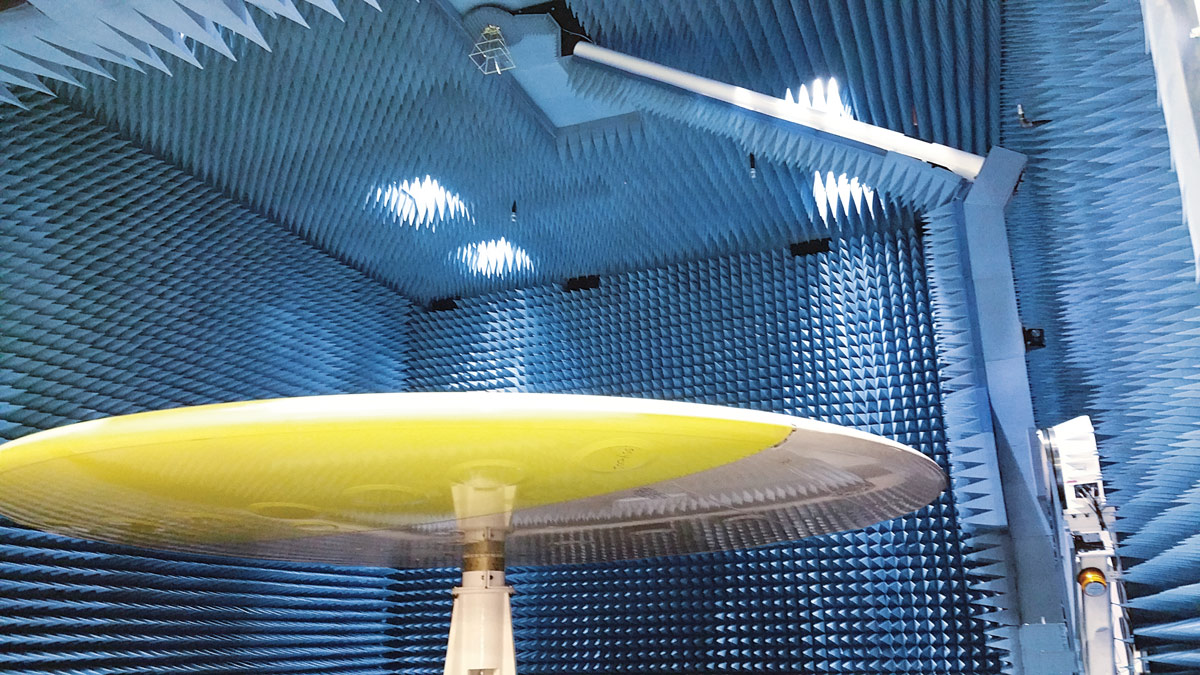
Swing Arm-over-Azimuth Systems
Features
- Scan area 360° roll and 360° to 95° in azimuth
- L-band to mmWave measurements
- Automatic electronic alignment capability
- Far-field, near-field, and holographic patterns
- Far-field measurement options available
Swing arm-over-azimuth systems are ideal system for measuring medium and low gain antennas up to 7.3 m (24 ft) in diameter. They are also well suited to perform testing of standalone antennas that fit inside this dimensional envelope.
-
Specifications
-
Applications
-
Capabilities
| Construction | Azimuth, roll, and pol rotation stages with “L” bracket (aluminum/steel) |
|---|---|
| Drive System | Precision Stepper Motor |
| Scan Area | 360° Roll and 360° to 95° in Azimuth |
| Maximum Antenna Load | 75 kg to 27,216 kg (165 lb to 60,000 lb) |
| Maximum Antenna Diameter | 0.5 m to 7.3 m (20 in. to 288 in.) |
| Resolution | 0.01° to 0.0007° Azimuth, Roll and Pol |
| Position Repeatability | 0.03° RMS to 0.015° RMS |
| Rotational Speed (Azimuth, Roll, Pol) | 5°/s to 180°/s |
| System Controller | NSI-MI controller with serial and parallel I/O interfaces |
| Measurement Workstation | Measurement workstation computer with large LCD monitor |
| Stepper Motor Power Amplifier | EIA 483 mm (19 in.) rack mount. |
| Motor Cables | Quick-connect; 12 m (40 ft) |
| Scanner Absorber | Absorber Kit (127 mm (5 in.) pyramidal) |
| Probe | Optional |
| RF Cables | 20 GHz RF Cables |
| Rotary Joints | Qty. 3 - DC-26.5 GHz, (Azimuth, Roll, Pol) |
| Supported RF Devices | NSI-MI Receiver Subsystem or selection of Keysight, Rohde & Schwarz and Anritsu VNA's (contact NSI-MI for a complete list) |
| Power | 100-240 VAC switchable, 50/60 Hz, 500 watts |
Dimensions
| Width | 1.8 m to 9.4 m (72 in. to 371 in.) |
|---|---|
| Depth | 1.8 m to 5.1 m (72 in. to 201 in.) |
| Height | 1.9 m to 7.0 m (74 in. to 276 in.) |
| Weight | 337 kg (750 lb) to 3,085 kg (6,800 lb) approx. |
The system interfaces with a wide variety of RF equipment and is capable of measuring amplitude and phase patterns from X-band to mmWave frequencies. The systems include NSI-MI Antenna Measurement Software.
The system software runs on a Windows-based measurement workstation and provides automatic setup of scans based on measurement parameters and desired output. Measured data can be processed for far-field or holographic patterns yielding complete characterization of the antenna’s performance. A single data set provides information on antenna gain, side lobe structure, beam pointing and cross polarization.
The systems can be supplied with a variety of options to enhance system performance.
The system software runs on a Windows-based measurement workstation and provides automatic setup of scans based on measurement parameters and desired output. Measured data can be processed for far-field or holographic patterns yielding complete characterization of the antenna’s performance. A single data set provides information on antenna gain, side lobe structure, beam pointing and cross polarization.
The systems can be supplied with a variety of options to enhance system performance.