




.svg?la=en&revision=cee9767f-8e72-4d76-a07a-14ba25688269&hash=ADF64722447408F8CA70B4436F59CB64)
Vector Digital Receiver
Model: ELE-VDR
Features
- Standard interface to receive high-speed serial or parallel digital data
- High data rates supported via 1 Gb Ethernet interface
- Simple upgrade path for existing analog RF measurement systems
- ANSI/VITA 49.2 standards-based protocol for input data stream
- Implemented using NSI-MI Vector Measurement Controller (ELE-VMC)
- Built-in timing master with 10 ns timing resolution
- Comprehensive AESA control interface, including NSI-MI’s Generic Beam Controller & RF Interface

The Vector Digital Receiver (VDR) is a precision measurement instrument incorporating the latest technology for making antenna, radome, and electromagnetic field measurements for devices with digital outputs. The VDR augments the Vector Field Analyzer™ (VFA) product line, unlocking the ability to acquire digital data directly from antennas with integrated A/D converters. This high-speed receiver is an enhancement to the trusted Vector Measurement Controller (VMC) hardware platform, giving it the ability to act as master timing controller for complex electronic measurement and data acquisition. The VDR supports various digital I/Q data formats at greater than 1 million measurements per second as well as a comprehensive set of tools designed to simplify the integration and test of electronically steerable antennas. The Vector Digital Receiver combines the best RF performance, fastest measurement speed, and most advanced features available in the industry to tackle the most complex measurement challenges.
Benefits of Vector Digital Receiver

Superior RF Performance
Interface directly to the digital output of your antenna to drive peak performance.

High-Speed Acquisitions
Maximize throughput with a high-speed digital interface supporting >1M measurements per second.

Command and Control
Test thousands of simultaneous beams on-the-fly using a robust set of command and control tools.
VMC Trusted Hardware Platform
The VDR uses the NSI-MI Vector Measurement Controller (VMC) as a hardware platform to implement its core capabilities. The VMC is a master timing controller for complex electronic measurement and data acquisition. It is used for fast, on-the-fly electromagnetic testing, precisely coordinated with mechanical motion or other controlled/monitored test attributes. As an enhancement to NSI-MI’s Vector Field AnalyzerTM, the VMC provides a comprehensive set of tools supporting the integration of analog AESA and multi-port antennas. A complete set of selectable trigger and data inputs and outputs gives the VMC the ability to control practically any device or instrument with precise timing resolution. The VDR requires the Digital AUT (ELE-VMC-DA) firmware version of the VMC, which unlocks its advanced AUT interface tools to integrate both analog and digital AESAs.

VMC Rear Panel

- A. Ten programmable BNC I/O: For triggers and responses; tri-color LEDs show input/output signal logic
- B. Universal AC input: 100 to 240 V AC
- C. Trigger Bus: Simple timing interface with other NSI-MI instruments
- D. Standard TTL interface: Beam steering / AESA control, triggering, GBCR
- E. Differential TTL interface: Beam steering / AESA control, triggering, GBCR, digital AUT data interface (parallel format)
- F. Dual 8-bit MUX: RF multiplexer, switch, or other control via parallel TTL
- G. USB, Console, SD card: Behind lockable service panel; removing the SD card clears instrument memory
- H. Dual Gigabit Ethernet: Control and digital AUT data interface (serial format)
Generic Beam Controller & RF Interface (GBCR)
GBCR is a generic interface developed to support the integration and test of analog and digital active antennas with complex needs for command and control. GBCR, included with the VDR, consists of several digital control lines, an Ethernet interface, and software tools to facilitate the task of coordinating AUT command for test and measurement purposes. GBCR supports virtually any antenna configuration imaginable, including antennas with multiple receivers, multiple beams, embedded sources, and more. Any device can be integrated with GBCR using our standard interface, which is published and delivered with the VDR, along with all necessary timing diagrams and GBCR programmer’s manual. This approach allows complex devices to be characterized at high speeds, without revealing any proprietary information about the AUT. GBCR has become a trusted interface for many customers due to its versatility, efficiency, and unintrusive nature.
Streaming Serial System Configuration
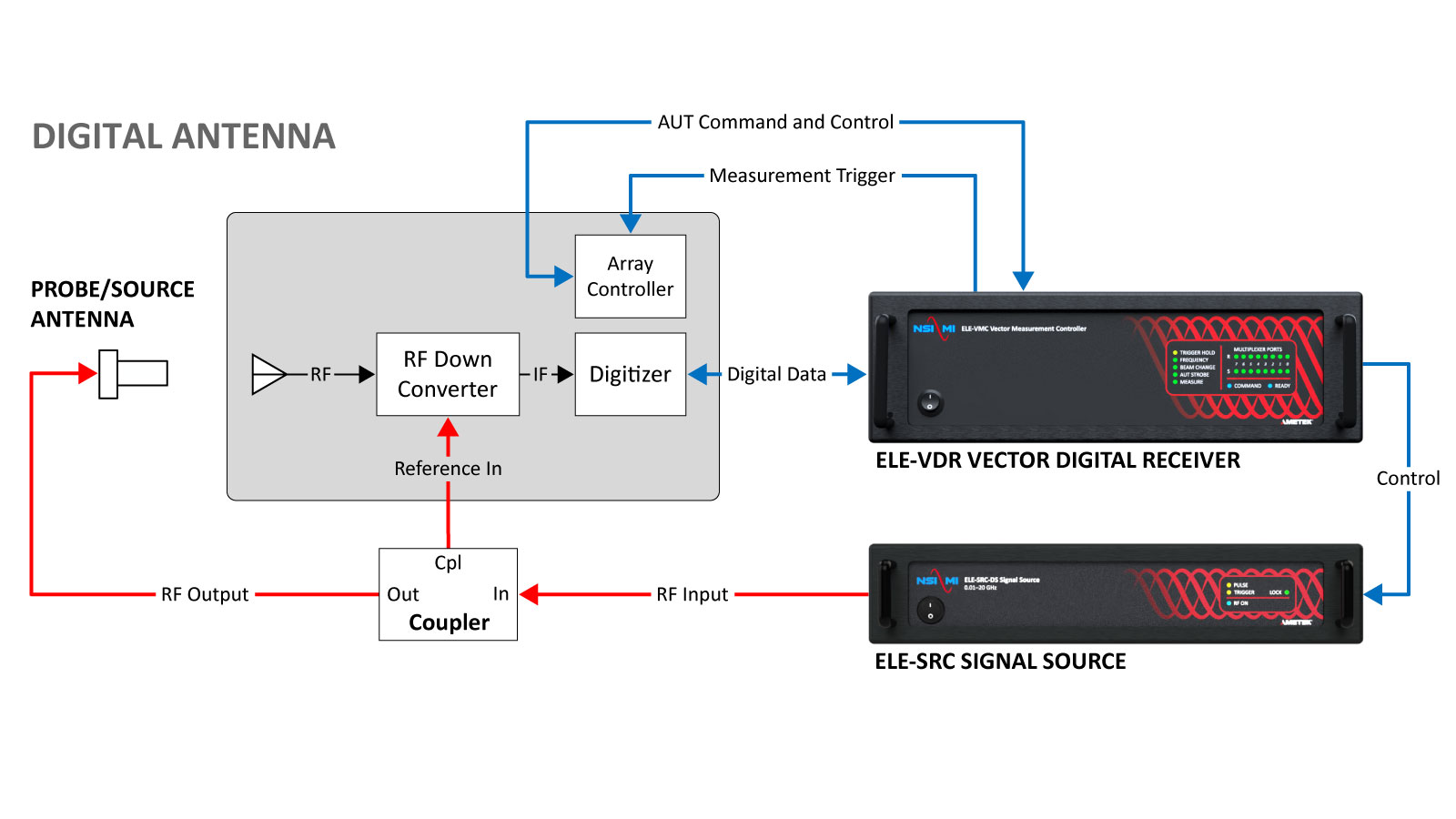
The VDR is specially designed to characterize antennas with integrated A/D converters. Most modern digital antennas output data as a stream of I/Q pairs, making conventional analog receivers ill-suited to this task. The VDR uses proprietary algorithms to capture the data stream, tag the measurements using discrete triggers, and store time & spatially synchronized I/Q data pairs into the database. The VDR, when combined with the NSI-MI Signal Source (ELE-SRC), provides a system-level solution for characterizing digital antennas operating in receive mode. The figure below shows a simplified block diagram of the VDR being used for Rx mode testing.
Dual-use Analog & Digital Test Systems
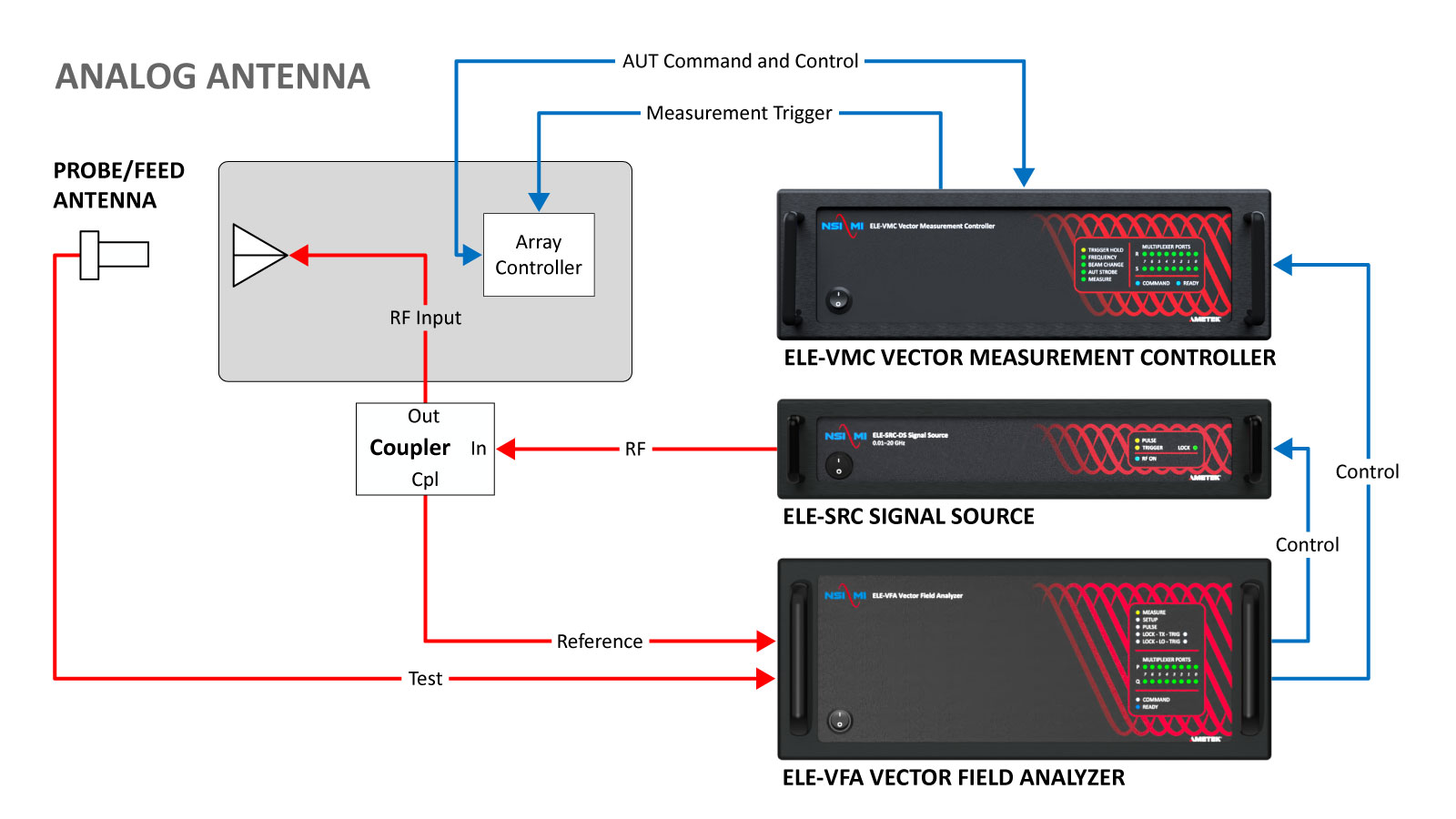
The VDR, when paired with the VFA, offers a flexible test system suitable for the characterization of passive, active analog phased arrays, and digital antennas. When configured for analog testing, the VMC is configured as system timing master and all AUT command and control capabilities, including GBCR, are available for integration and test. The result is the most efficient and flexible RF measurement system available. A simplified block diagram of a transmit antenna being tested with the dual-use system is shown below.
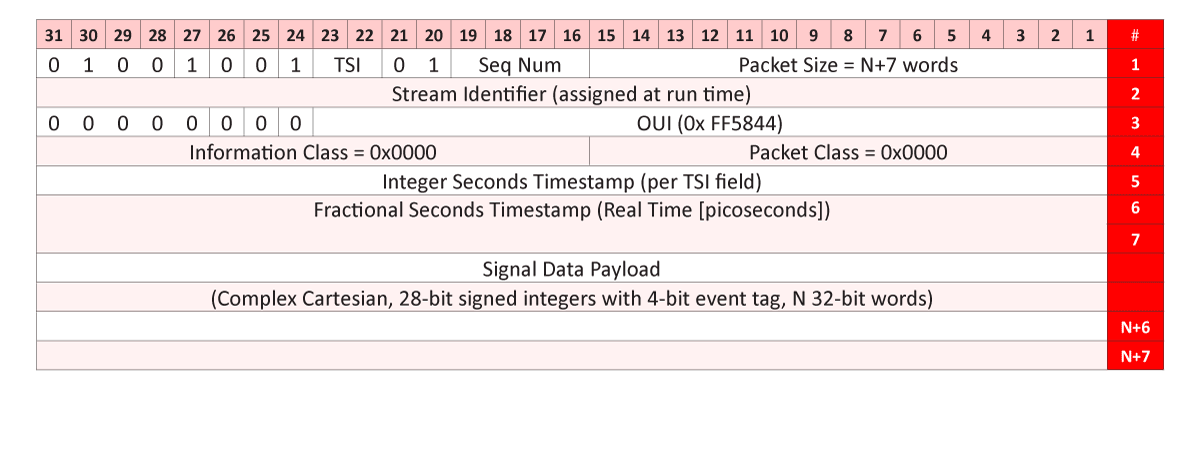
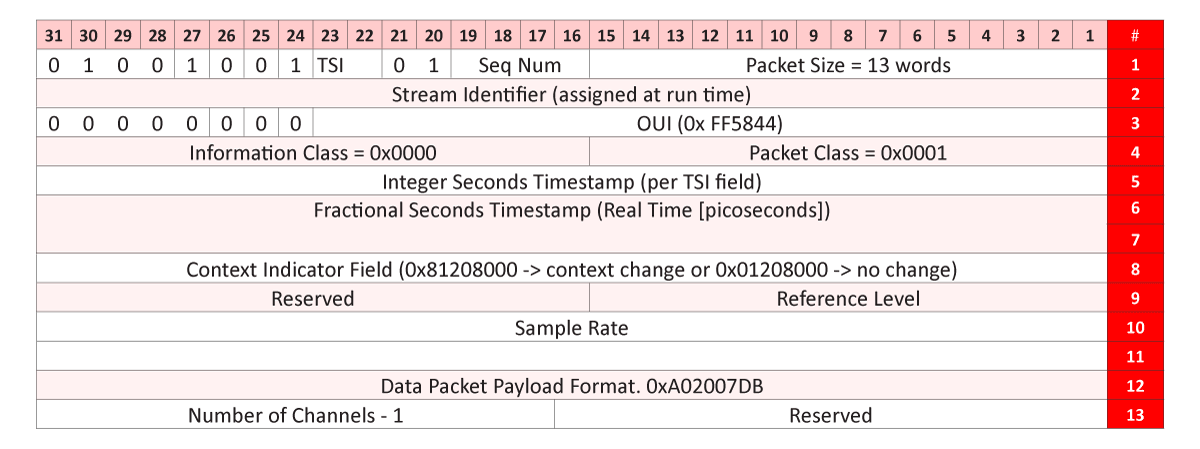
VDR serial mode uses a published standards-based protocol for the reception of streaming data. The VDR uses an open and transparent standard based on the Digital Intermediate Frequency Interoperability (DIFI) Consortium’s design to meet a broad set of needs for the transmission of digital data. DIFI is an application of VITA 49.2, which defines standardized packet formats for carrying digitized spectral information. Adoption of this standard format allows the VDR to interface to all types of digital antennas without the need to know any proprietary information about the data stream. Simply adapt the output to match the expected 28-bit I/Q packet format shown below and your antenna is ready for integration using the VDR. Note that the packet format is undergoing periodic updates and improvements and the data shown here may not be up to date. The current packet format and ICD will be furnished with the VDR. Data rates are limited by the 1 Gb Ethernet VDR data port. Options for higher data rates are available upon request. Contact NSI-MI for more information.
Data Packet
Context Packet
Digital AUT Emulator
Due to the sensitive nature of many digital antennas, it is not always possible to validate system performance with final hardware. Two types of Digital Antenna Emulators are available to ensure that the VDR is performing to specification.
First, a Software Emulator (ELE-VDR-SWE) is included with every delivery of the VDR. This software emulator is installed on the measurement workstation, where packets conforming to the standard are uploaded and sent via Ethernet to the receiver. The acquisition software configures the system and reads back measurement data. Various parameters are configurable, including the sample rate, packet size, and network details. Captured data is monitored and cross-checked for errors upon reception. Emulator source code can be made available to fast-track customer interface development.
The Hardware Emulator (ELE-VDR-HWE) provides users with a real piece of test equipment meant to stand-in for the final AUT. The hardware option is implemented as an upgrade to the VFA receiver. The VFA will capture the ratio of the output of a passive antenna to a stable reference signal and will stream the results to the VDR over Ethernet using the VITA 49.2 standard format. The VDR will send timing triggers to the emulator for data tagging. When delivered as part of a VDR system to act as emulator, the VFA can also be used as analog receiver, making for a powerful, dual-use test system. Learn more about the VFA here.
-
Specifications
-
Ordering Guide
| Timing Latency | |
|---|---|
| Hardware Input Response | ~20 ns |
| Hardware Output Response | ~10 ns |
| VNA Read After Sweep Complete | ~1 µs |
| Digital Data Formats | |
| DR Parallel | Beam Steering Port: RS-485 parallel I/Q data |
| VDR Serial | 1 Gb Ethernet Port: Streaming digital I/Q data |
| VDR Serial Data Standard | ANSI/VITA 49.2 |
| VDR Serial Data Rate | > 1M measurements per second |
| Beam Steering/AUX TTL interfaces - 2 ports | |
| Data | 20 data bits |
| Control signals | Strobe, acknowledge |
| Logic level | Beam interface: RS-485 equivalent Auxiliary TTL Interface: single-ended TTL compatible |
| DC power | +/- 18 VDC |
| Multiplexer interfaces - 2 ports | |
| Compatibility | ELE-MUX product family |
| Control signals | 8 differential bits per port |
| Logic level | RS-485 equivalent |
| DC power | +/- 18 VDC |
| Timing latency | |
| Hardware input response | ~20 ns |
| Hardware output response | ~10 ns |
| Receiver read after sweep complete | ~1 µs |
| Model Number | Description |
|---|---|
| ELE-VDR | Vector Digital Receiver base package, includes ELE-VMC-DA |
| ELE-VDR-SWE | Software emulator for ELE-VDR validation and test |
| ELE-VDR-HWE | ELE-VFA based hardware emulator for ELE-VDR validation and test |