




.svg?la=en&revision=cee9767f-8e72-4d76-a07a-14ba25688269&hash=ADF64722447408F8CA70B4436F59CB64)
Active Antenna Test Suite
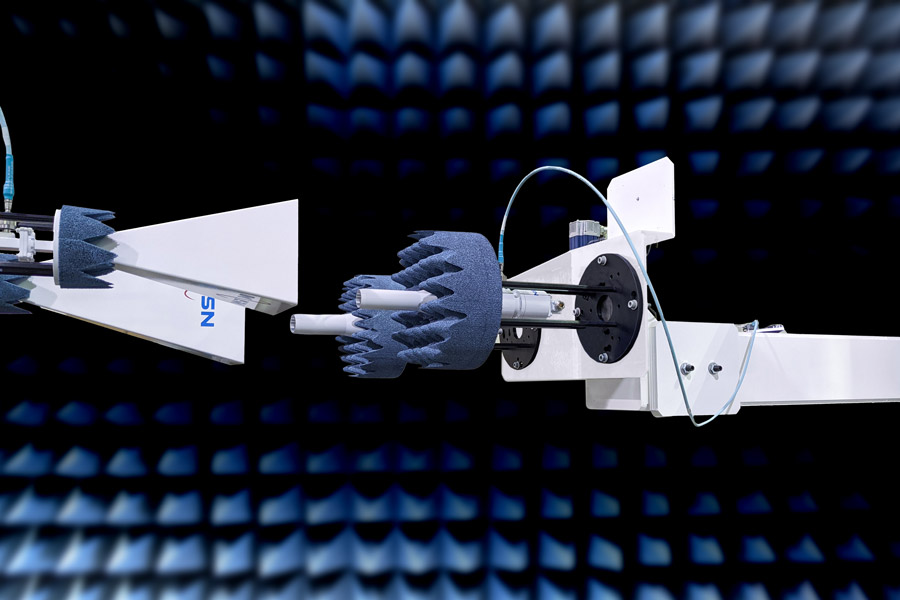
Model: SYS-AATS
Active antenna systems use various electronic components to control the phase and amplitude weighting of individual elements or groups of elements to modify the array’s aperture distribution. The addition of these active components often necessitates system-level characterization of the antenna system in addition to the typical component-level testing required for simpler, passive antennas. NSI-MI Technologies offers our customizable Active Antenna Test Suite (SYS-AATS) with the necessary hardware and software to fully characterize system-level parameters for antenna systems. SYS-AATS is ideally suited for characterizing Active Electronically Scanned Arrays (AESA) and transponders on both near-field and far-field test systems. SYS-AATS is designed to expand measurement capabilities for advanced communications systems for telecommunications, SATCOM, over-the-air, in-flight WiFi antennas, and other commercial applications.
The SYS-AATS product line is a customizable add-on package to any new or existing antenna measurement system and includes options to support the characterization of a number of active parameters, as described below. The specific hardware and software configuration included with each SYS-AATS delivery will be customized based on the system measurement requirements. Each package includes the baseline software suite to automate data acquisition and processing for system-level characterization. The user interface and experience will reflect purchased options and capabilities. The RF test hardware integrated for system-level testing can be furnished by NSI-MI or supplied by the customer to make use of existing assets.
- Full antenna pattern characterization
- Equivalent Isotropic Radiated Power (EIRP)
- Gain-over-Noise-Temperature (G/T)
- Saturating Flux Density (SFD)
- Group Delay (GD)
- Transponder channel response
- Customizable user interface
- Support for customer-furnished hardware
Datasheet
System-level Parameter Characterization
- Transmit/receive path full pattern characterization for active antenna systems
- Equivalent Isotropic Radiated Power (EIRP)
- Transmit path Equivalent Isotropic Radiated Power (EIRP)
- Receive path Gain-over-Noise-Temperature (G/T)
- Receive path Saturating Flux Density (SFD)
- Antenna or end-to-end Group Delay (GD)
- Antenna or end-to-end Gain Frequency Response (G(f))
 Simplified configuration for end-to-end testing with NSI-MI Vector Field Analyzer™ and SYS-AATS
Equivalent Isotropic Radiated Power (EIRP)
EIRP is the power that an isotropic radiator will have to transmit to lead to the same power density that the AUT will affect at a specific angle of interest. To characterize EIRP, a two-stage process is used:
- Perform complete pattern acquisition (near-field) or peak relative power determination (far-field) of the transmitting antenna using the RF sub-system configured for pattern measurements, as shown in (a).
- Connect the power meter to the probe/feed output and record the absolute power level as shown in (b). This is automated using a low-loss two-port switch assembly.
The end-to-end process of EIRP data acquisition and processing can be fully automated using the SYS-AATS.(1)
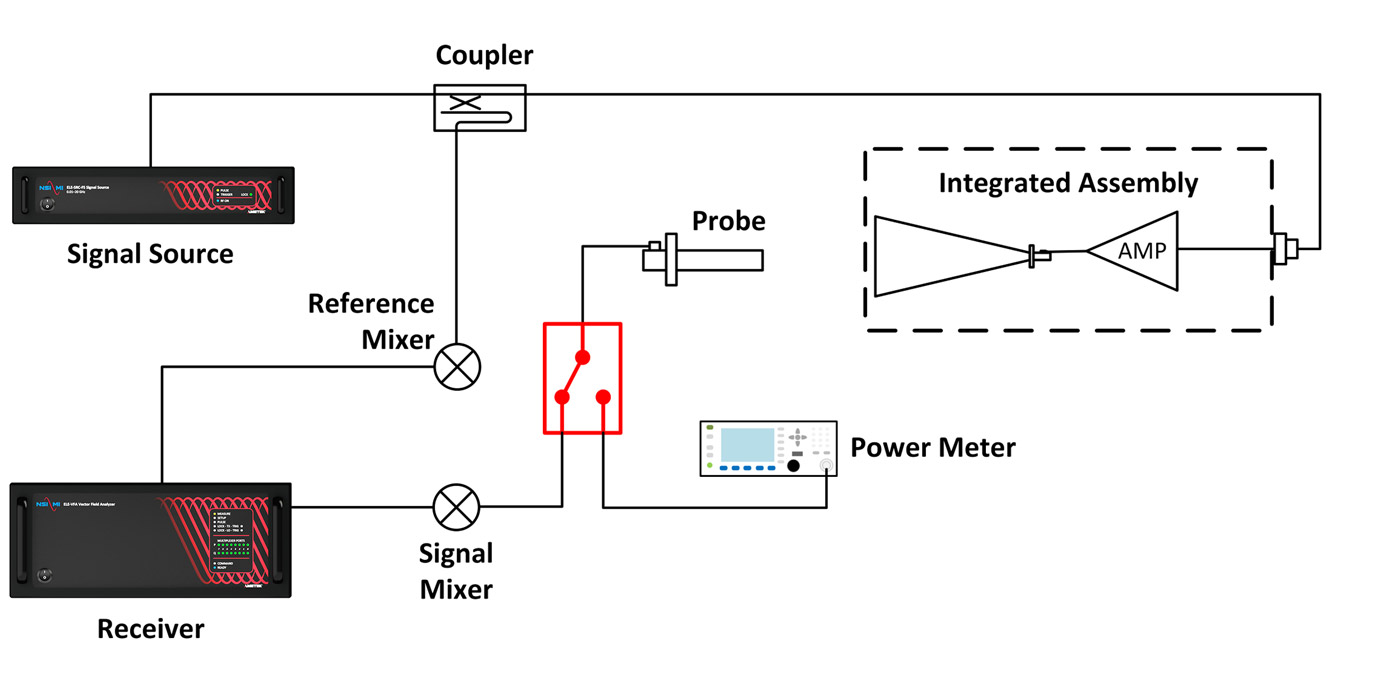 (a) EIRP Stage 1 - Pattern Measurement
 (b) EIRP Stage 2 - Power Meter Measurement
Saturating Flux Density (SFD)
SFD is the flux required to saturate the receiver of an AUT. To characterize SFD, a two-stage process is used:
- Perform complete pattern acquisition (near-field) or peak relative power determination (far-field) of the receiving antenna using the RF sub-system configured for pattern measurements, as shown in (a).
- Connect a power meter to the probe/feed input and record the incident power level as shown in (b). This is automated using a low-loss two-port switch assembly.
The end-to-end process of SFD data acquisition and processing can be fully automated using the SYS-AATS.(1)
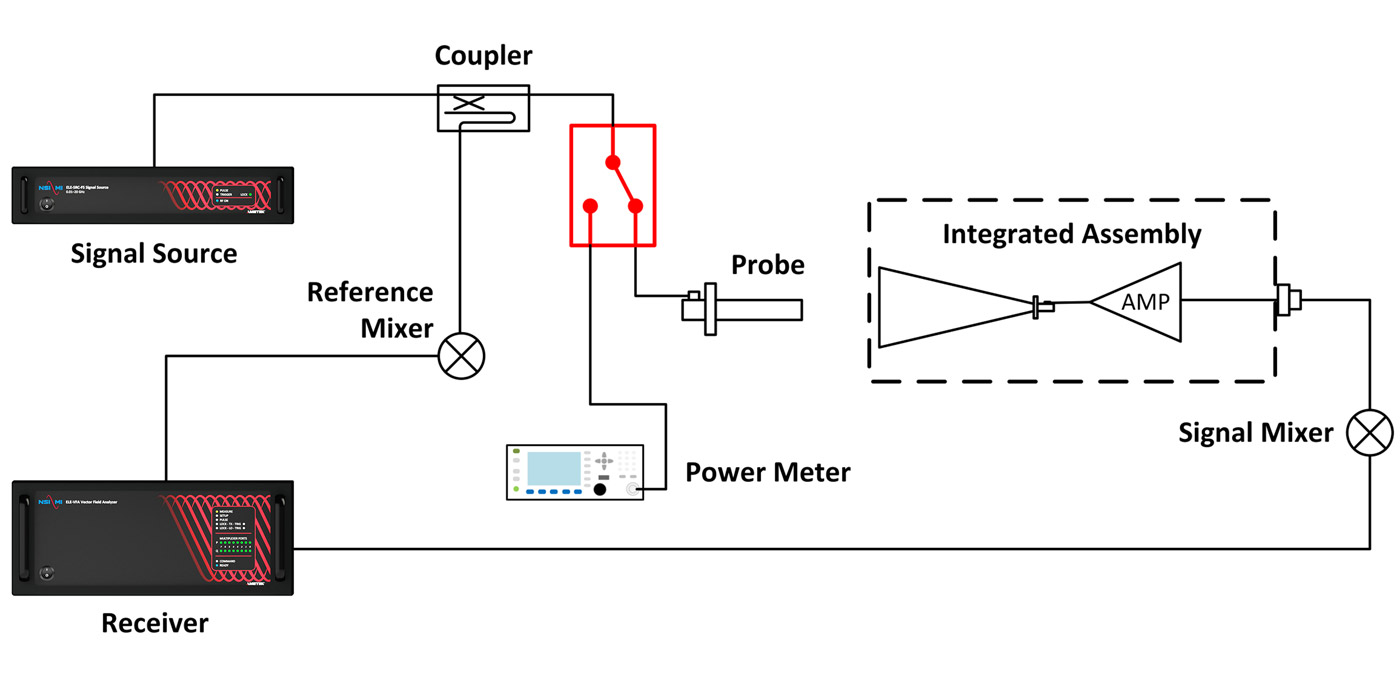 (a) SFD Stage 1 - Pattern Measurement
 (b) SFD Stage 2 - Power Meter Measurement
Gain-Over-Noise Temperature (G/T)
G/T is a figure of merit for a receiving antenna, used in calculating link budgets to determine signal-to-noise ratio (SNR) at a receiving antenna’s output port. G/T is measured in the near-field using the CW-Ambient technique:
- Perform complete pattern acquisition (near-field) or peak relative power determination (far-field) of the receiving antenna using the RF sub-system configured for pattern measurements, as shown in (a).
- Measure the receiving antenna’s noise output power in a “quiet” anechoic environment with source power turned off using a spectrum analyzer as shown in (b).
- Measure the receiving antenna’s signal output power using a spectrum analyzer as shown in (c).
- Connect a power meter to the probe/feed input and record the incident power level as shown in (d). This process is typically automated with a power divider or RF switch.
The end-to-end process of G/T data acquisition and processing can be fully automated using the SYS-AATS.(1)
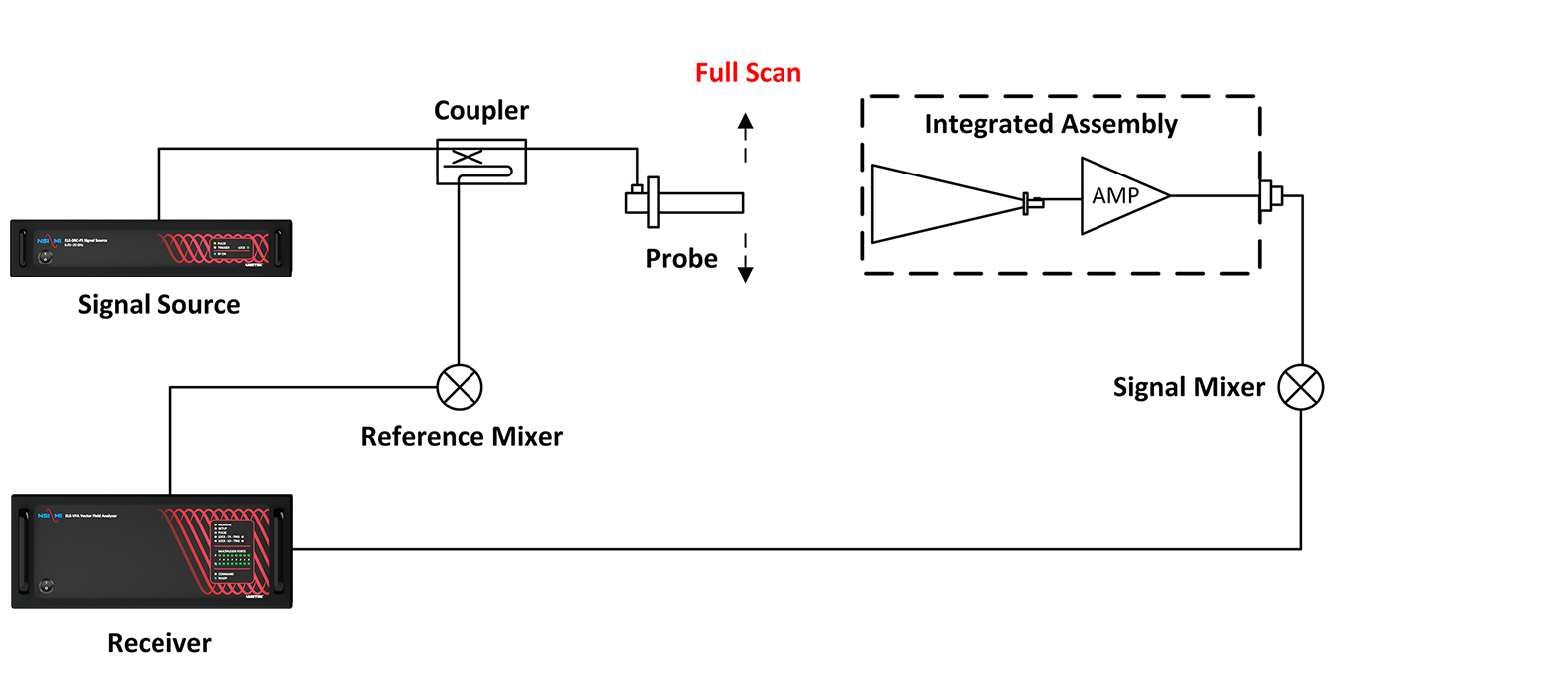 (a) G/T Stage 1 - Pattern Measurement
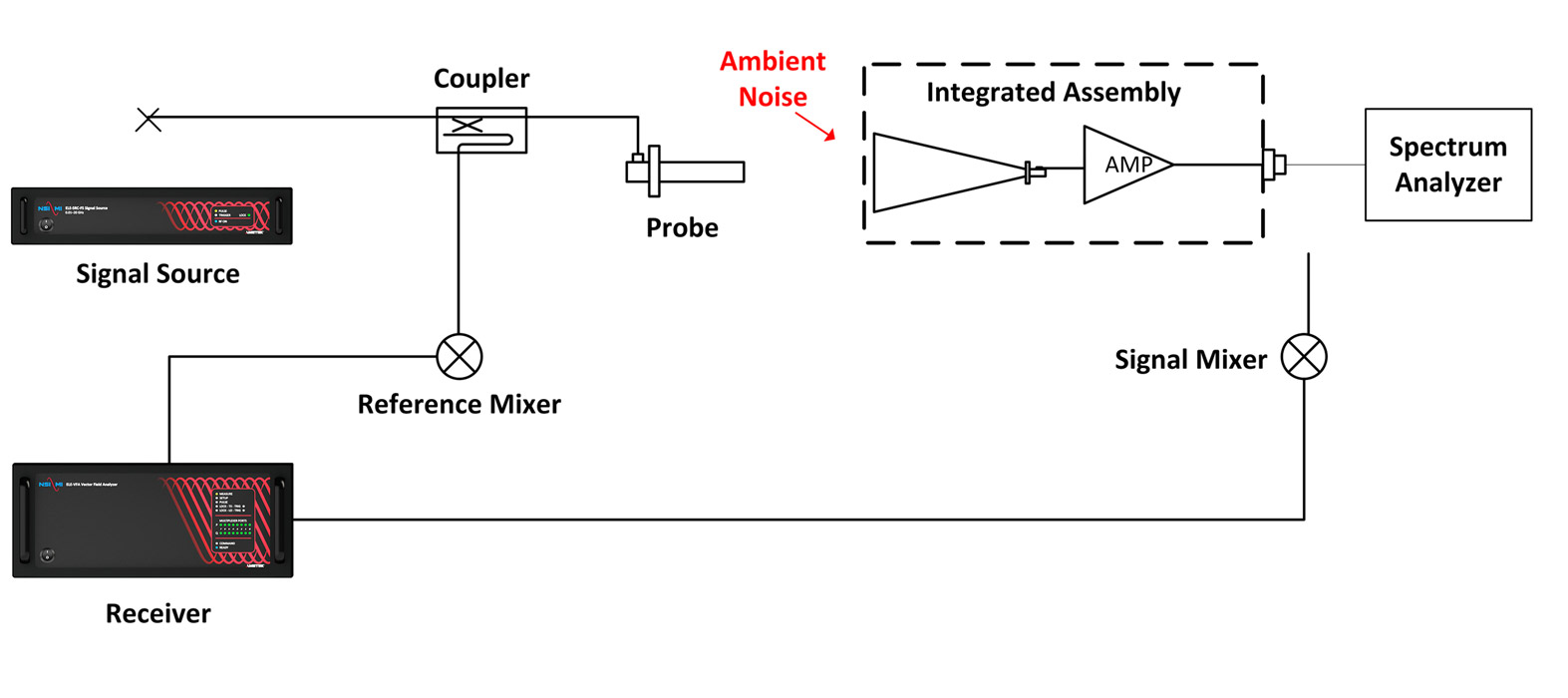 (b) G/T Stage 2 - Ambient Noise Measurement
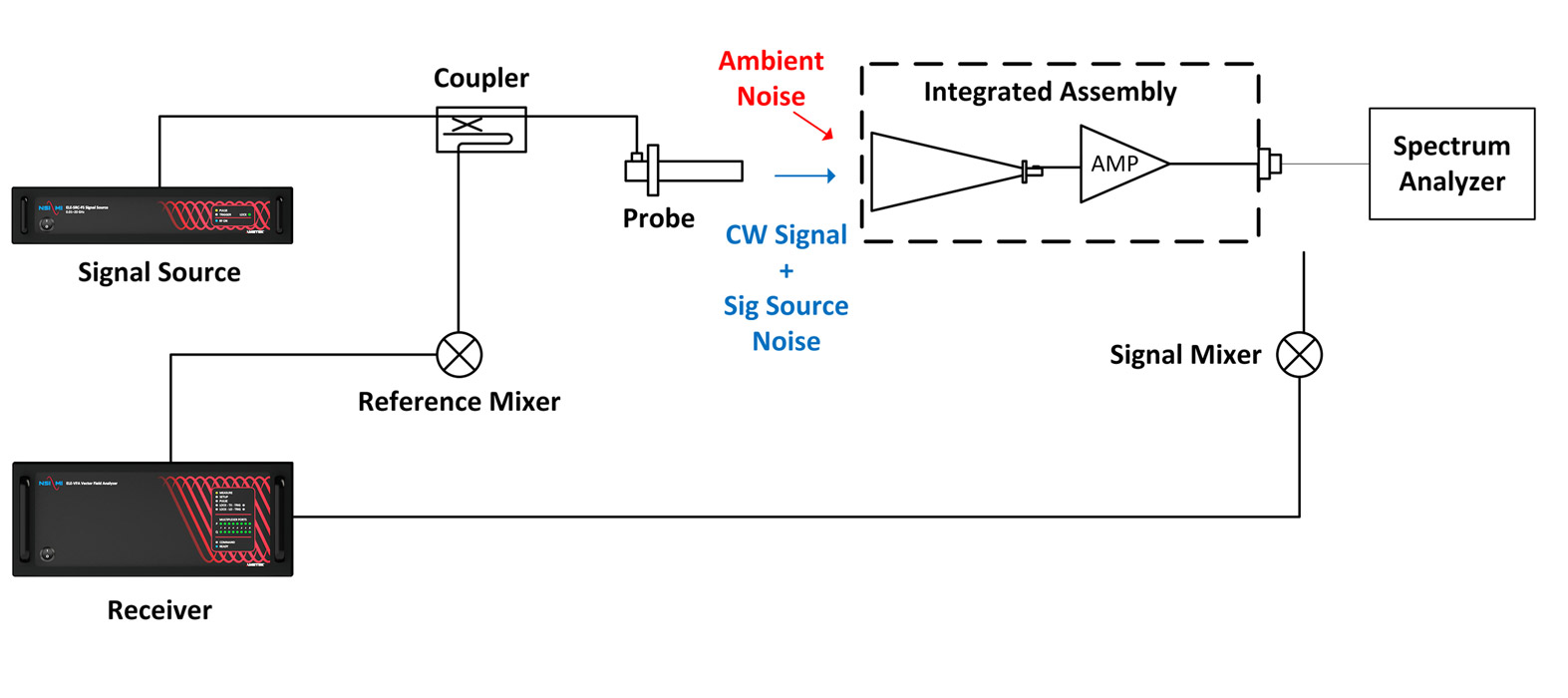 (c) G/T Stage 3 - Signal Power Measurement
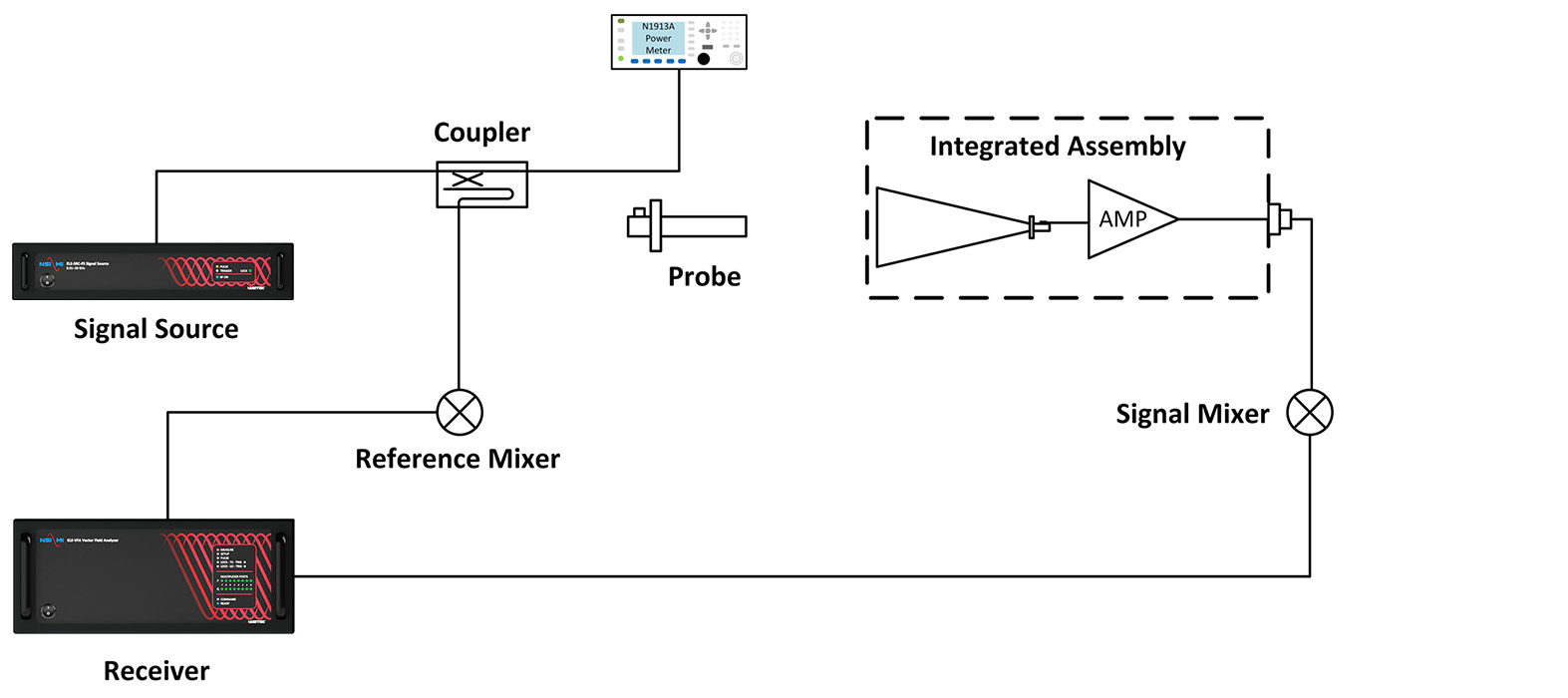 (d) G/T Stage 4 - Power Meter Measurement
(1) Contact NSI-MI for a list of supported third-party power meters and/or spectrum analyzers.