




.svg?la=en&revision=cee9767f-8e72-4d76-a07a-14ba25688269&hash=ADF64722447408F8CA70B4436F59CB64)
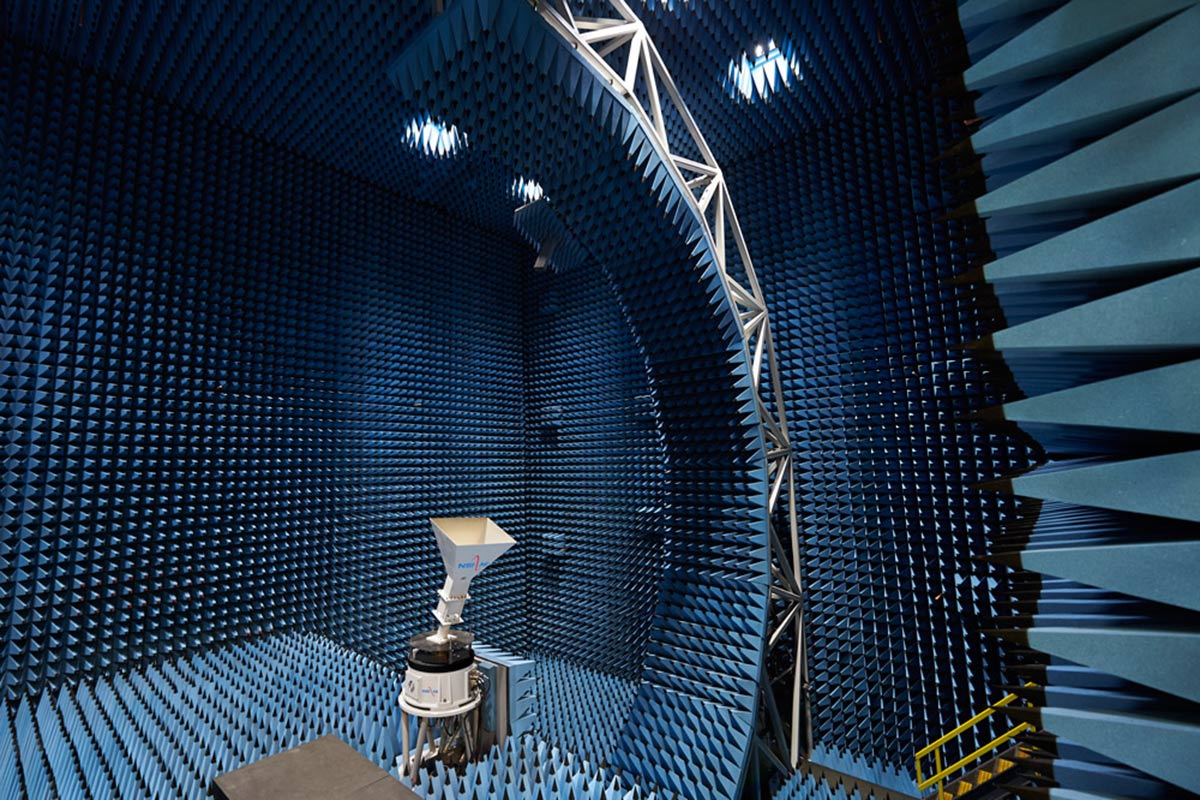
Arch-over-Azimuth Scanner Systems
Features
- Ideal for spherical near-field antenna measurements
- Up to 10 m (33 ft) scan radius
- ± .005° angular position accuracy
- 0.05 mm (0.002 in.) RMS radial accuracy
- 90°, 115°, 135°, and 180° versions
- Capable of handling a wide range of antennas from 0.1 - 140.0 GHz
Spherical scanning is accomplished by rotating the antenna-under-test (AUT) on an azimuth positioning system while elevation scans are accomplished using a near-field probe mounted on the arch carriage. Phase and amplitude data is collected as the AUT rotates.
-
Specifications
-
Applications
-
Available Add-Ons
| Nominal Scan Radius (to Probe Mounting Surface) | 1.2 m to 10 m (3.9 ft to 33 ft) |
| Elevation Travel Options1 | 90º, 115º, 135º, 180º |
| Elevation Position Accuracy | As low as 0.002 (90º) (Deg RMS) |
| Planarity of Scan Circle2 | As low as 0.076 (90º Travel) (mm RMS) |
| Elevation, Maximum Speed | 1.2°/s |
| Radial Axis Travel2 | 102 mm (4 in.) |
| Radial Position Accuracy2 | 0.05 mm (0.002 in.) RMS |
| Radial Axis, Maximum Speed | 25 mm/sec (1 in./sec) |
| Roll Axis, Maximum Load Capacity | 29.5 kg (65 lb) |
| Roll Axis, Travel Options | Continuous, ± 120º |
| Roll Axis, Position Accuracy2 | 0.02°/s |
| Roll Axis, Maximum Speed | 12°/s |
| Maximum Load Capacity | 29.5 kg (65 lb) |
| Operating Environment | Indoors |
| Temperature, Measuring | 20°C, ± 2 |
| Temperature, Operating) | 10°C to 40°C |
| Humidity, Survival (% Relative Non-Condensing) | 20 to 90 |
¹Note: Custom Travel Available.
²Note: Achievable.
Dimensions
| Width | 2.1 m to 17.9 m (7 ft to 59 ft) |
|---|---|
| Depth | 5.8 m to 13.7 m (19 ft to 45 ft) |
| Height | 4.8 m to 17.3 m (16 ft to 57 ft) |
| Weight | 4,536 kg to 24,947 kg (10,000 lb to 55,000 lb) |
NSI-MI’s arch scanners can be configured with NSI- MI’s Motion Control and Laser Technology to achieve even higher levels of measurement accuracy. This option can be used to characterize and compensate for errors that are repeatable. The compensation is determined as a combination of an off-line calibration procedure prior to measurement and several real-time updates to that calibration during the measurement. The motion of the near-field probe is compensated in real time to follow the calibrated path that will minimize position errors.