




.svg?la=en&revision=cee9767f-8e72-4d76-a07a-14ba25688269&hash=ADF64722447408F8CA70B4436F59CB64)
Range Automation System
Model: ELE-RAS
Features
- Modules available for 20 GHz and 50 GHz systems
- Supports automated range reversal, band switching, and more
- Highly configurable and customizable
- Modular architecture supports remote and rack mount installation
- SRF shielded enclosures eliminate RF leakage
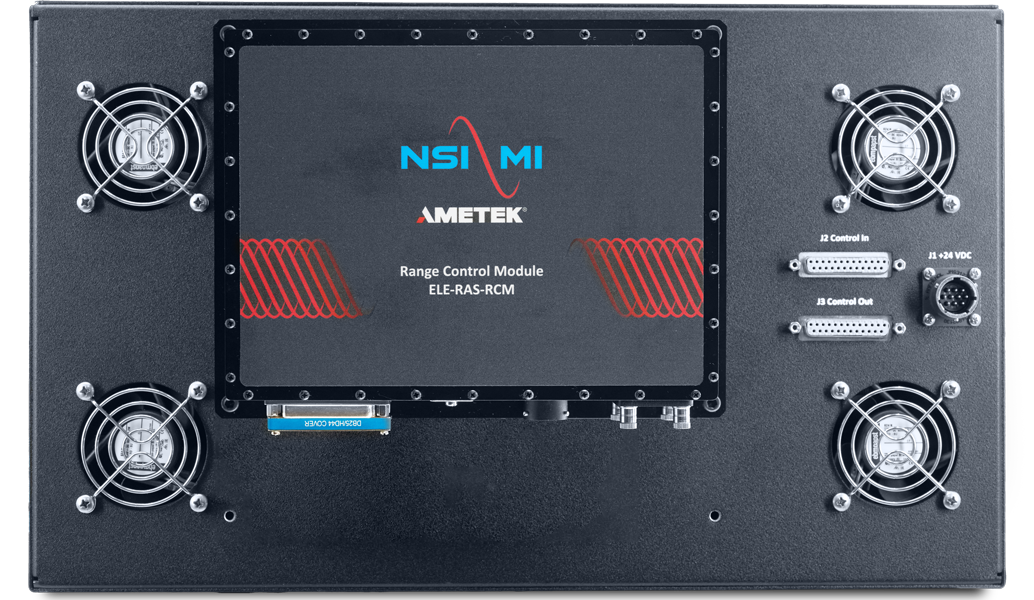
- Range Control Module (ELE-RCM) can manage 24 modules up to 30 m away
- Software agnostic modules have their own user interface and programming command set
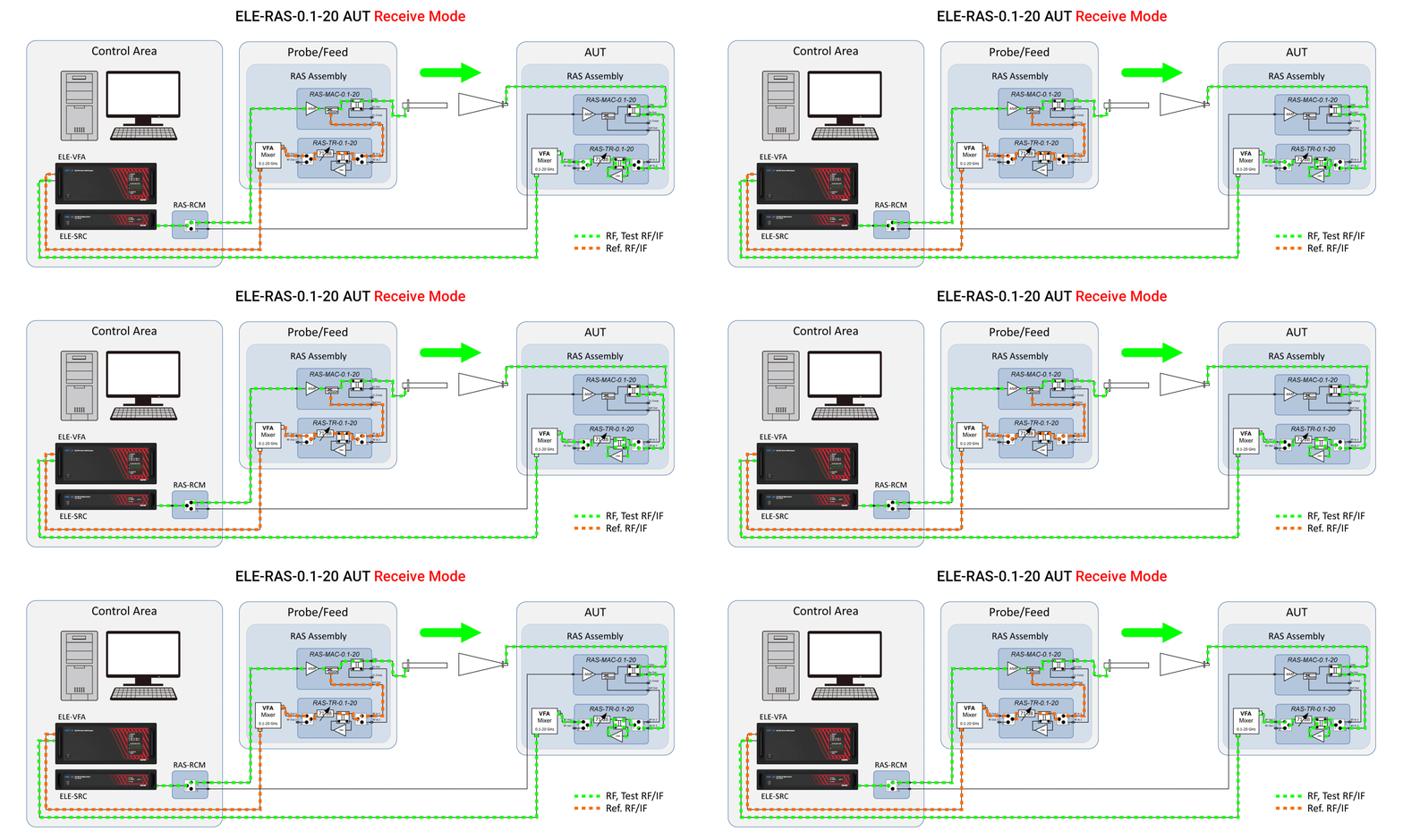
- Support for special range modes, including mixer bypass, system calibration, Active Antenna Test Suite (AATS) support, plus more
What is Range Automation System
NSI-MI’s Range Automation System (ELE-RAS) has been specially designed to automate the time-consuming tasks associated with antenna range reconfiguration. This system eliminates operator intervention for range reversal, band switching, and power level optimization in antenna measurement facilities. This hands-off approach reduces uncertainty, extends the life of sensitive components, reduces RF leakage, and dramatically increases throughput and productivity. The modular architecture allows each ELE-RAS system to be optimized for maximum performance. ELE-RAS is software and receiver agnostic, meaning that it can be used to improve efficiency in virtually any antenna test range. Standard solutions are available for 20 GHz and 50 GHz applications. The ELE-RAS architecture also supports custom solutions to meet your unique measurement challenges.
Modular Architecture
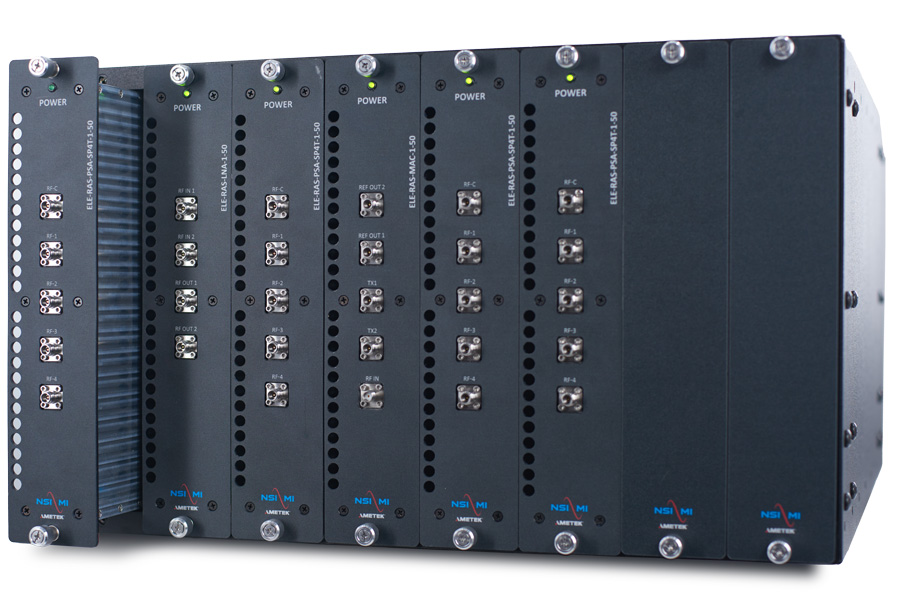
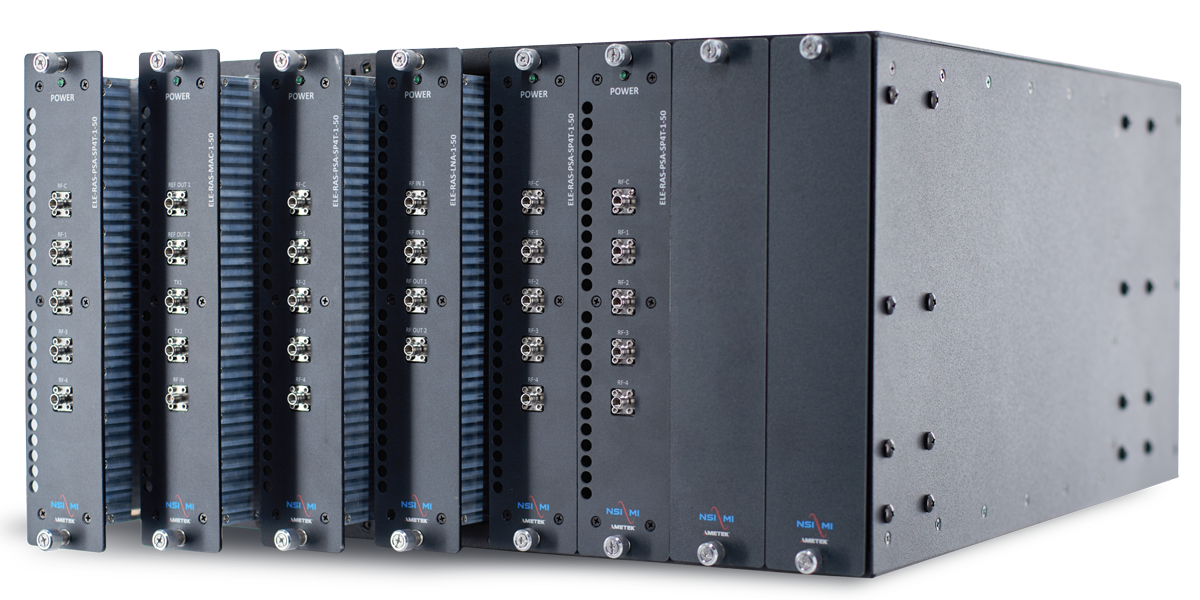
The ELE-RAS has been designed with maximum flexibility and performance in mind. NSI-MI can configure a ELE-RAS solution to meet your needs by configuring a solution that maximizes performance for your application. ELE-RAS is controlled by one or more Range Control Modules (ELE-RCM), which can each control a maximum of 24 modules, up to 30m away. This allows RF modules to be installed in the optimum location, whether that is in an RF equipment rack or mounted directly to a measurement system. When multiple modules are used together, we recommend installing them in a rack mount or remotely installed 4U or 6U chassis. The ELE-RAS chassis can control multiple modules using a single control connection from an ELE-RCM, and multiple chassis can be daisy-chained together. The chassis features a quick-connect design to quickly and safely install or remove ELE-RAS modules without risk of damage.
ELE-RAS Software and Control
Each ELE-RAS solution includes one or more Range Control Modules (ELE-RCM). The ELE-RCM houses a single- board computer that communicates with the system’s host computer using an Ethernet interface. Upon startup, the ELE-RAS-RCM takes on the role of the server, while the host computer functions as the client in a client-server setup. Operators interface with ELE-RAS modules via the standard user interface, which is automatically adapted to the RF modules detected in the system. This simple interface allows users to efficiently update all supported RF parameters from the system’s control area. The ELE-RAS is also designed to operate as a SCPI (Standard Commands for Programmable Instruments) device allowing range operators to fully automate range reconfiguration tasks between measurements.

Minimizes Test Time
Allows for near-instantaneous test configuration changes, eliminating the need for time-consuming manual relocation of electronic RF components and cables.

Improves Test Repeatability
Ensures consistent results from one scan to the next, minimizing the need for product retesting.

Better Configuration Control
Software-controlled configuration ensures repeatability and allows for rapid test configuration changes.

Increases Reliability
Less chance of connector, cable, or component damage.

Reduces Errors
Minimizes user involvement with fixed cables and components, along with pre-defined software settings for different test configurations.



-
Specifications
-
Applications
-
Options
-
Includes
ELE-RAS Standard Configurations
20 GHz and 50 GHz ELE-RAS configurations are described below. Standard and enhanced packages are available.
| ELE-RAS-0.1-20 | ELE-RAS-1-50 | |
| Frequency Range | 0.1 – 20.0 GHz | 1.0 – 50 GHz |
| Baseline Features | Range Reversal Rx/Ref Attenuation Control Rx/Ref Amplification Secondary Tx Output |
Band Switching Range Reversal Rx/Ref Attenuation Control Rx/Ref Amplification Secondary Tx Output |
| Enhanced Package Features | All Baseline Features, plus: EIRP Mode AUT Calibration Mode AUT RF System Health Check Standard Gain Horn Mode |
|
| Rx/Ref Attenuation Control | 0 dB to 71 dB with 1 dB step size | |
| Rx/Reference Amplification | 33 dB typical gain | |
| Band Switching | N/A | X1 band: 1 – 20 GHz X2 band: 20 – 40 GHz X4 band: 33 – 50 GHz |
| Tx Output Power (typical) | +17 dB | X1 band: +17 dBm X2 band: +14 dBm X4 band: +11 dBm |
| Maximum Rx Power | 1W CW | |
| Mode Switching Speed (typical) | 15 ms | |
| ELE-RCM Max. # of RF Modules | 24 | |
| ELE-RCM Max. Control Distance | 30 m | |
- Automotive antenna testing
- General antenna testing
- Satellite antenna testing
- Wireless
- Phased array antenna testing
- Production environments
The Range Automation System is typically configured as a full solution:
- ELE-RAS-0.1-20: 0.1 – 20 GHz baseline configuration
- ELE-RAS-0.1-20-EP: 0.1 – 20 GHz, enhanced package
- ELE-RAS-1.0-50: 1.0 – 50 GHz baseline configuration
- ELE-RAS-1.0-50-EP: 1.0 – 50 GHz, enhanced package
Custom packages and modules are also available. Contact NSI-MI for more information.
The ELE-RAS Range Automation System includes all necessary hardware to fully implement an optimized measurement system, including:
- All necessary RF modules
- One or more RAS chassis, if applicable
- One or more RCM units
- RF jumper cables, as required
- Control & AC cables, as required
- SCPI programmer’s guide